Structure Determines Function
In 1953, Francis Crick and James Watson walked into the Eagle Pub in Cambridge and announced they had found the "secret of life." They hadn't found a mystical energy source; they had found a shape. The Double Helix.
Crick later famously said: "If you want to understand function, study structure."
This principle—that physical form dictates behavioral capacity—is ignored by modern software engineering. We try to force Python to be a systems language. We try to force JavaScript to be a backend language. We ignore the structural reality of the tools we use.
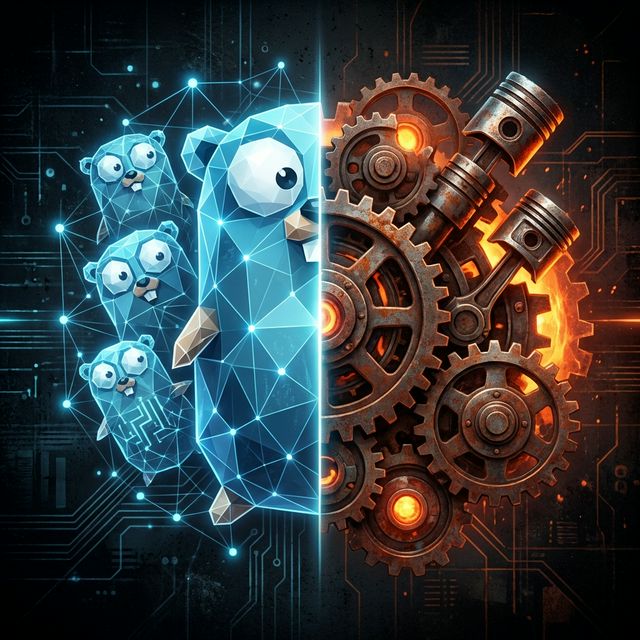
At R3F, we return to first principles. The anatomy of an AI system is not a monolith. It is a biological duality, requiring two distinct types of tissue: The Nervous System and The Muscle.
1. The Nervous System (Go)
Norbert Wiener, the father of Cybernetics, described the nervous system not as a generator of force, but as an "automatic machine" for decision-making. Its purpose is signal propagation, coordination, and control. It does not lift the weight; it decides when to lift the weight.
An AI Agent is a Nervous System. It is a long-running, stateful process that orchestrates multiple tools, context windows, and network requests simultaneously. To an Agent, latency is thought. If your orchestration layer is blocked by the GIL (Global Interpreter Lock), your agent is lobotomized.
Why Go is the Perfect Neuron:
- Goroutines: We can spawn 10,000 concurrent "thoughts" (tool calls) with negligible overhead. This mimics the massive parallelism of neural pathways.
- The Synapse: Go's channels (
chan) are the closest software equivalent to a synaptic gap—a typed, safe, blocking mechanism for signal transfer between independent processes. - Simplicity: The context window is limited. We want the code to be boring so the logic can be complex.
// The Agent Loop: High Concurrency, Low Cognitive Load
func (a *Agent) Think(ctx context.Context, input string) (string, error) {
  // 1. Parallel Tool Execution
  // Go makes concurrent reasoning trivial.
  results := make(chan ToolResult)
  for _, tool := range a.tools {
      go func(t Tool) {
          results <- t.Execute(ctx, input)
      }(tool)
  }

  // 2. Aggregate Thoughts (Dendritic Integration)
  var context []string
  for i := 0; i < len(a.tools); i++ {
      res := <-results
      context = append(context, res.Output)
  }

  // 3. Synthesize (Call the Engine)
  return a.engine.Chat(context)
}
The Gopher manages the complexity. It is the conductor.
2. The Muscle (Rust)
Below the Agent lies the Engine. This is the Inference Server, the Vector Database, the RAG Pipeline.
In biology, muscle tissue is specialized for one thing: Contractility. It converts chemical energy (ATP) into mechanical force. It is expensive, it generates heat, and it must be efficient.
Physiologist Albert Szent-Györgyi noted that muscle contraction is a fundamental property of living matter, governed by the "sliding filament theory" of Actin and Myosin. There is no room for garbage collection here. A missed cycle is a tremble in the hand.
Why Rust is the Actin/Myosin:
- Safety without GC: A Garbage Collector (like Go's) is fatal in a tight inference loop. You cannot have "stop-the-world" pauses when streaming tokens. It breaks the illusion of intelligence.
- Zero-Cost Abstractions: Rust allows us to write high-level code that compiles down to the same assembly as hand-tuned C. It is the raw conversion of electricity into math.
- SIMD: Rust's ownership model allows safe, aggressive optimizations for Single Instruction, Multiple Data operations—the software equivalent of recruiting more motor units.
// The Engine: Raw Power, Zero Abstractions
use ndarray::Array2;

pub struct InferenceEngine {
  weights: Array2<f32>,
}

impl InferenceEngine {
  // No GC pauses here. Pure linear algebra.
  // This is the Actin sliding over the Myosin.
  pub fn forward(&self, input: &Array2<f32>) -> Array2<f32> {
      let result = input.dot(&self.weights);
      // Apply activation function (RELU) in-place for cache locality
      result.mapv(|x| x.max(0.0))
  }
}
The Crab handles the weight. It is the engine block.
3. The Interface: The Neuromuscular Junction
In the body, the nerve meets the muscle at the Neuromuscular Junction. A chemical signal (Acetylcholine) crosses the gap and triggers a physical contraction.
In our architecture, this junction is the FFI (Foreign Function Interface) or gRPC.
For local systems, we use C-Shared Libraries. Rust exposes a C-ABI, and Go consumes it using cgo. The "thought" (Go) instantly triggers the "action" (Rust) within the same process memory space.
Conclusion: Specialized Sovereignty
Don't be a maximalist. Evolution wasn't. It didn't make the brain out of muscle fibers, and it didn't make the heart out of neurons.
If you write your Agent in Rust, you are fighting the Borrow Checker when you should be iterating on prompts. You are building a brain out of bone. If you write your Inference Engine in Go, the Garbage Collector will stutter your token stream. You are trying to lift a heavy weight with a nerve.
Respect the structure. Use Go to think. Use Rust to act.